

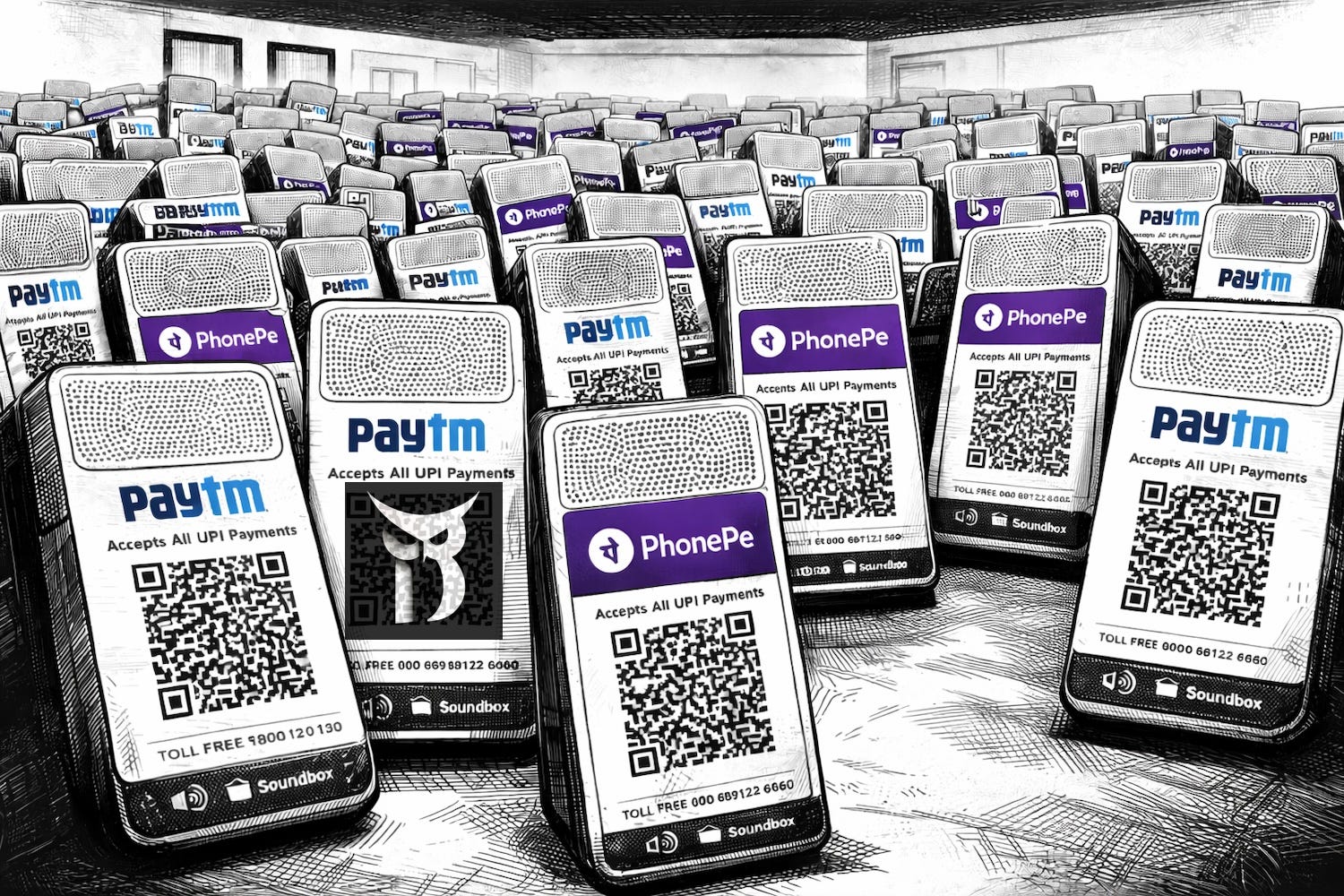
India’s UPI payment platform moved an economy’s worth of money in FY25, but one of the largest net revenue line items in the ecosystem was not a payment product. It is a plastic speaker that sits on a shopkeeper’s countertop and confirms incoming payments aloud. The roughly 23 million soundboxes deployed across India earn about $220 million a year in rental fees — more than every explicitly UPI-linked line item in the revenue pool combined.
Bernstein estimates the net payment-processing revenue pool for Indian payment platforms at roughly $1.7 billion in FY25, net of processing costs and before operating expenses. (The volume denominator is messy because platform-reported GMV often double-counts across consumer and merchant sides and can overlap across payment categories.)
Card transaction processing is the largest line item at about $496 million, on take rates that Bernstein estimates to be 15-20 basis points. Online payments/payment gateways are second at about $441 million, on 5-10 basis points — a platform-fee layer earned over and above interchange, regardless of which rail clears the payment. Soundbox rentals are third.
Everything that follows is smaller and getting squeezed. Consumer-side bill payments earn $165 million. Merchant-side UPI debit earns $77 million. RuPay credit card on UPI earns $11 million on the consumer side and $33 million on the merchant side. Prepaid instruments and buy-now-pay-later products earn about $110 million — a high-margin bucket that hasn’t grown much given regulatory constraints and stagnant wallet volumes. Peer-to-peer UPI earns $66 million on $1.87 trillion in value. (UPI accounts for more than 90% of all payment transactions in India.)
Each soundbox earns its platform $7-10 a year, paid as a monthly rental. That revenue is not linked to transaction volumes and not subject to NPCI-governed take rates.
The device costs a few dollars ($7-12) to manufacture and assemble. In the early days of UPI, most Indian merchants had phones that could not reliably display real-time payment notifications, so a customer could — and many did — scan, pay and walk away while the shopkeeper had no idea whether the money had arrived. The soundbox was built to fix that.
Paytm has the largest installed base at about 13 million devices as of H1 FY26. PhonePe has about 8.5 million. The rest is split among newer entrants including Google Pay and several banks. The total installed base grew from about 9 million in FY23 to 23 million in FY25 and Bernstein projects that to reach 40 million by FY30.
The monthly rental price sits around 80-300 rupees (88 cents to $3.3), though the realised pricing could be lower — the margin bridges for Paytm and PhonePe both assume about 60 rupees per device per month, reflecting promotional discounting and competitive pressure. Per-device revenue has been compressed over the years, but the installed base has grown fast enough to offset the decline. Industry device revenue is expected to reach about $275 million by FY30, according to industry estimates.
Every other revenue stream in Indian payments has followed the same downward trajectory on take rates. Debit card MDR was pushed down over time; UPI and RuPay debit have been at zero MDR since 2020. Government subsidies meant to compensate platforms for processing free UPI transactions have declined from 8.7 basis points of UPI merchant payment value in FY22 to 2.7 basis points in FY25. Industry projections already model take rate compression on RuPay credit card on UPI — the newest product on the stack — from 8 basis points to 5 on the consumer side and from 20 to 15 on the merchant side over the next five years.
Soundbox rentals are the exception. The platform owns the device, contracts the hardware, employs the salesforce that places it, and sets the price in a direct negotiation with the merchant.
In H1 FY26, Paytm’s total payments revenue was about $295 million. Device rentals contributed roughly $52 million. The rest, after subtracting $133 million in processing costs, left about $58 million in net payment processing revenue. Paytm earned nearly as much from renting out speakers as it did from processing all of its transactions across all payment types.

PhonePe processes about 48% of all UPI transactions in India. Its net payment processing revenue in H1 FY26 was about $83 million. Its device revenue was about $34 million. Running nearly half of India’s real-time payment infrastructure earns PhonePe only 2.4 times what it makes from renting speakers to shopkeepers.
The soundbox also makes the rest of the UPI economics work for companies. It is how platforms acquire merchants — a physical object on a countertop that locks in a relationship, routes transactions through the platform, and creates the data trail that supports merchant lending. Bernstein recently estimated that Paytm earns about $45 in total annualized revenue per device when payments and lending are included, against about $34 at PhonePe. Without the device, the platform has no merchant relationship and no reliable way to earn the credit card processing, UPI routing, or loan revenue that makes up the rest of its business.
The transaction processing business generates single-digit basis point margins on infrastructure the platforms do not own, under terms set by the regulator, on rails whose fees have been compressed or zeroed out in every prior iteration. The soundbox — a device that costs a few dollars, earns $8-10 a year in rent, and does nothing more than announce that money has arrived — is the closest thing the industry has to a business it actually controls.