

The lead photograph in Bloomberg Businessweek’s India story last month showed a factory outside Chennai, a 160-acre compound of assembly floors and nine hostel towers where more than 150 buses ferry about 40,000 workers through three shifts a day making iPhones. The story it opened, on how Apple and India built an alternative iPhone production hub, was the glossy culmination of five years of mounting excitement about one of the biggest ideas in global manufacturing, China Plus One.
The global business press and countless investors have spent recent years describing “Apple’s quiet pivot to India” with much excitement — and perhaps, rightfully so. Global giants are trying to cut their exposure to China and New Delhi is spending billions on incentives to lure them in.
But whether the world’s largest democracy has delivered, five years on, is somewhat narrower than what many stories may suggest.
India’s industrial economy is certainly growing and more capable than the familiar account of stagnation allows. But its gains are narrow in sector and geography, and they are thinnest where the country needs them most: jobs.
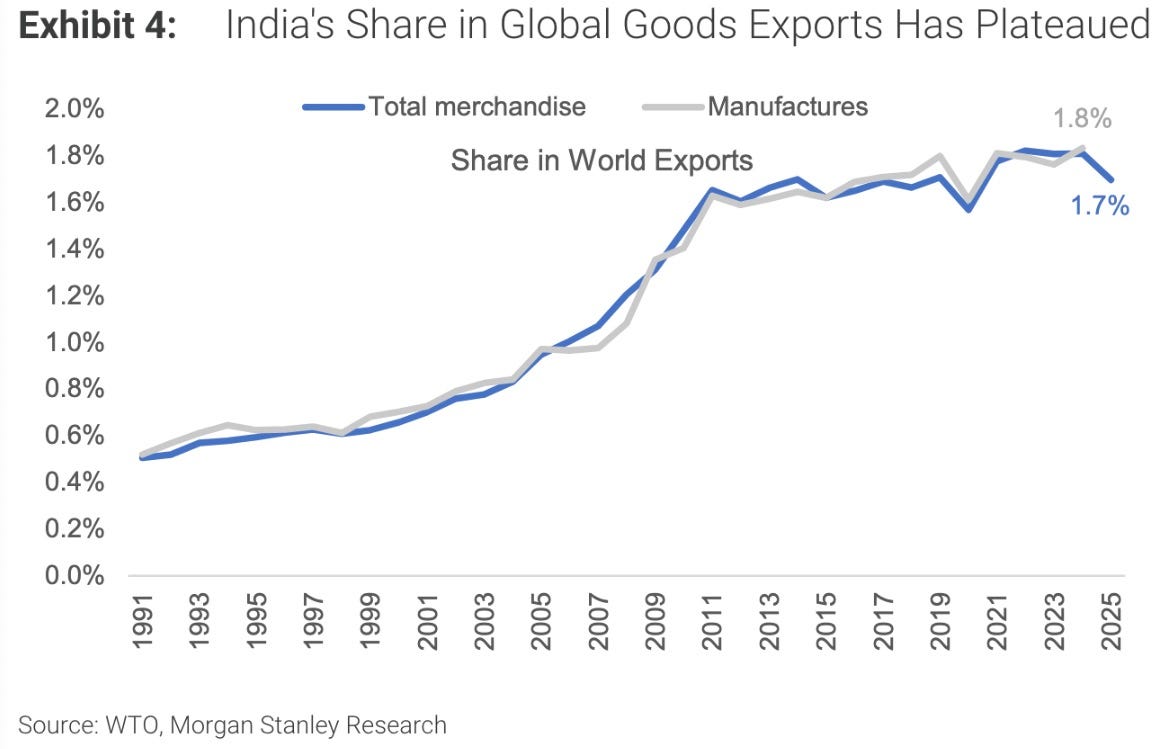
Manufacturing makes up about 15-16% of India’s economy. That share has barely moved in a decade and it continues to sit well below the 25% target the government has long set for itself. India’s share of global goods exports remains under 2%, even after the electronics boom and years of foreign companies looking for alternatives to China.
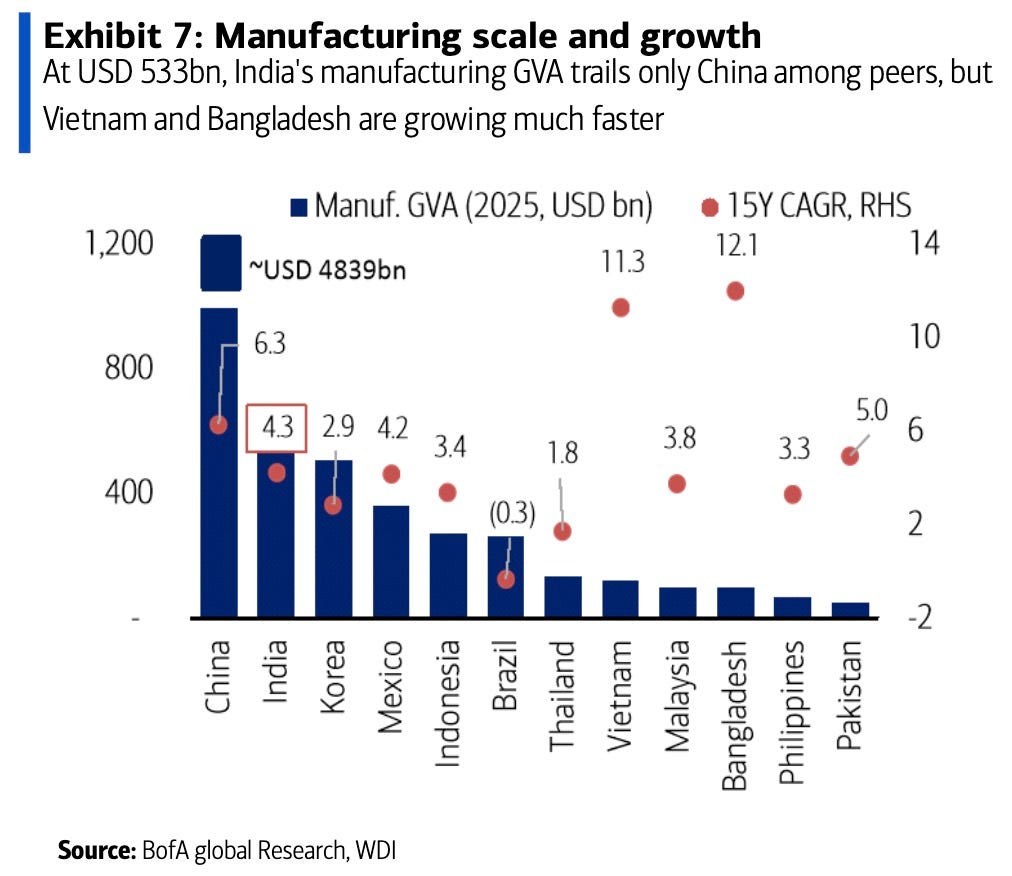
Indian manufacturing was worth about $533 billion in 2025. Over the longer term, the country’s share of global manufacturing has climbed from about 1% to 3%. And though India’s output has generally grown faster than the world’s manufacturing as a whole, it has struggled to become a larger part of India’s own economy.
To be sure, that could partly be explained by a growing demand at home. India has built large businesses in automobiles, petrochemicals and other industries and its high tariffs have protected local manufacturers. New Delhi has encouraged foreign companies to set up factories in India to compete for the same customers. As a result, the size of the Indian market has allowed a lot of industrial expansion without manufacturers having to win a matching share of customers abroad.
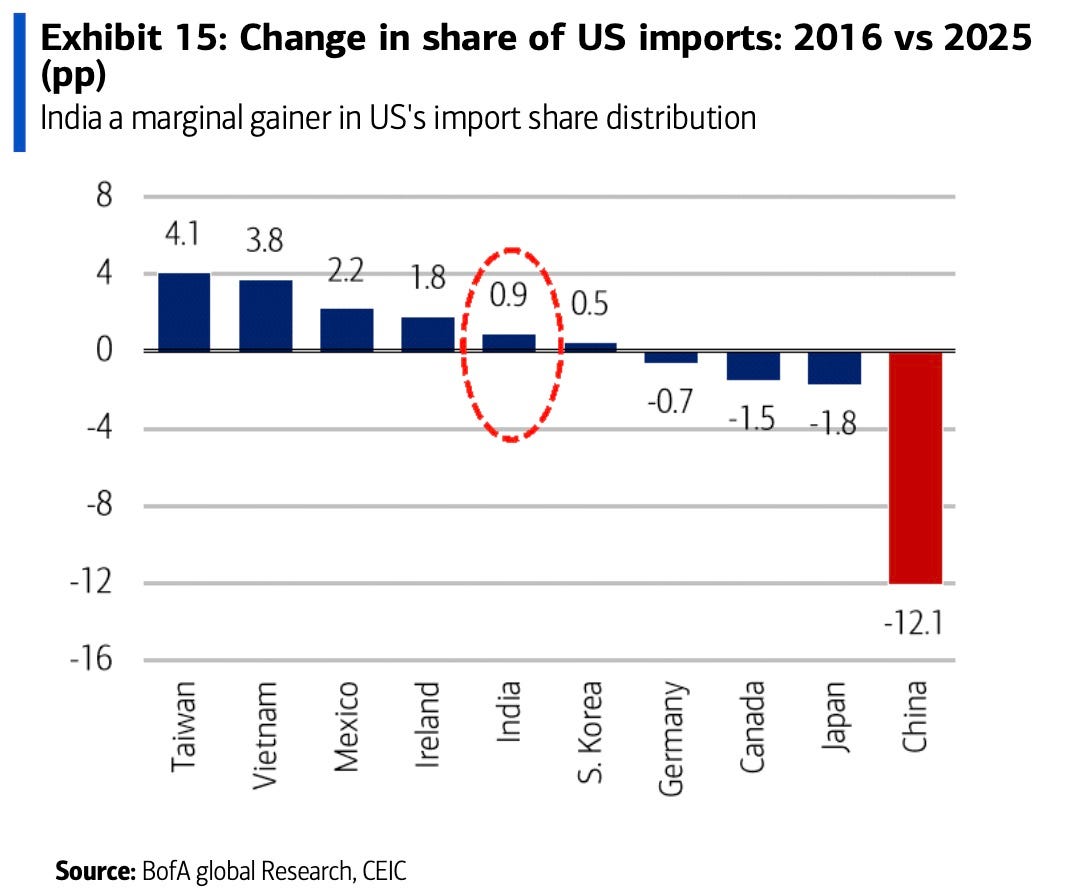
But it’s also true that some other countries have been bigger beneficiaries of the China Plus One movement. Between 2016 and 2025, China’s share of U.S. goods imports fell to 9% from 12%, according to official data. It was Taiwan, Vietnam and Mexico that picked up most of what China lost. The world’s most populous nation is expected to assemble 28% of the world’s iPhone shipments this year. Mobile phones have already overtaken diamonds as the country’s biggest export product.
Morgan Stanley credits Apple and its suppliers with more than 250,000 direct and indirect jobs since New Delhi began paying production-linked incentives to manufacturers, and says women hold more than 70% of those jobs. That is the strongest evidence so far that electronics can create jobs in India. Agriculture still employs nearly 60% of all working women in the country, according to official data. Bloomberg story found women in their early twenties, many from landless families, earning about 20,000 rupees ($210) a month on the assembly line. “I helped pay off a loan for my parents, thanks to my stable income,” Prithi, a 24-year-old assembly worker, told the publication. “Someday, maybe, I too can save enough to buy an iPhone.”
That programme began within weeks of Narendra Modi’s re-election in 2019, when a small group of officials met technology executives, Apple among them, for two hours, Bloomberg reported. “As you are aware, a golden opportunity has come knocking at our doors,” Nripendra Misra, then the prime minister’s principal secretary, wrote in a private letter shortly afterward. Months later the cabinet approved $4.3 billion in subsidies for mobile phone manufacturing over five years.


India made about 55 million iPhones in the 12 months to March, more than $25 billion worth, and exported almost 80% of them, mostly to the U.S. For the first time, all four models of the newest iPhone generation — to be unveiled tomorrow — are being assembled in India in time for their launch.
One of the mobile scheme’s original goals was that 25-30% of the value of the phones would be added in India. And that’s where the story starts to deviate. Jefferies says that target “appears unachieved.” In other words, assembly has moved to India but the more valuable components are still made abroad. India imported $116.2 billion of electronics in the year to March and exported $48 billion, according to government data.
Making camera modules and displays takes more upfront investment than assembling phones. Money can go in one or two years before production starts but the technology is hard to come by.
For what it’s worth, New Delhi has been paying attention and broadening its ambitions. Its answer is the Electronics Component Manufacturing Scheme, a subsidy programme for parts makers whose budget stands at $4.2 billion after a 75% increase. The government has approved at least 106 applications across five rounds, including projects to make printed circuit boards, camera modules and displays. Imports currently supply 85-90% of India’s roughly $5 billion market for circuit boards, according to Jefferies.
But it’s also true that approved applications aren’t factories yet. Across all of the government’s production-linked incentive schemes, companies had invested about $25 billion as of March, while New Delhi had paid out about 18% of the money it originally set aside, according to official data.
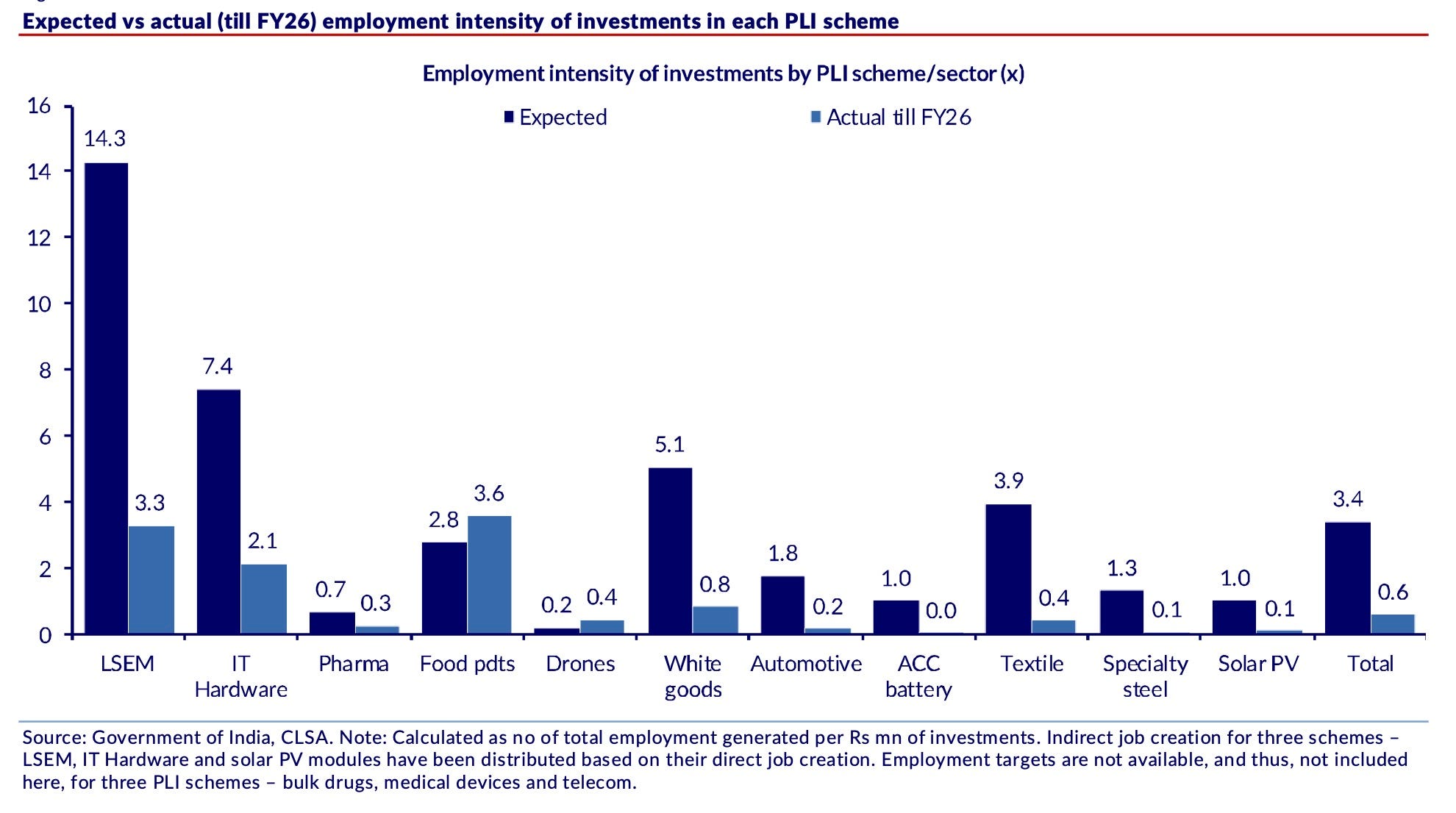
The largest shortfall is in jobs. In September 2021, the government expected the schemes to create at least 10 million jobs. By March 2026, they had created 1.42 million, direct and indirect, according to a CLSA tally of official data. Investment had reached about 82% of what the government projected and production about 60%. Jobs reached only 14%. The electronics scheme was expected to create about 14 jobs for every ~$10,600 invested. It has created about three, on CLSA’s calculation, because companies invested nearly three times what was expected and created fewer jobs than planned.
The smaller businesses expected to supply the assembly plants keep running into a similar set of challenges that have held back some of India’s older industries. A small manufacturer can face as many as 1,400 compliance requirements in a year — about 998 of them distinct — and worse, they often run due on an irregular schedule, BofA wrote in a note this week.
Furthermore, the Indian industry pays 10-25% more for its electricity than that electricity costs to supply. The Vietnamese industry, in comparison, pays about 10% less than its power costs to supply. A production subsidy from New Delhi, hence, can make up for only part of that handicap.
Similarly, the trade deals India has signed are used less than they could be. Only 20-30% of Indian exports that qualify for lower tariffs under free-trade agreements actually claim them, BofA estimates, against 60-70% in developed markets. Many smaller firms, for one reason or another, conclude that the paperwork is not worth the modest savings.
Manufacturing is also concentrated in a few places. Half of India’s factories are situated in five states — Tamil Nadu, Gujarat, Maharashtra, Karnataka and Uttar Pradesh, according to official data. The 10 districts that export the most account for nearly 38% of the country’s goods exports, and the top 100 for nearly 88%.
One fix is industrial clusters, which would put component makers, materials suppliers, tooling and testing facilities around larger manufacturers, on ready land with reliable utilities. If you add financing for suppliers, easier access to technology and help with certification, you’ve something. A big factory at the centre of a cluster can offer the prospect of more orders. But a supplier still has to pay for its machinery and working capital at the same costs as everyone else.
The two-wheeler industry already has that kind of network, and that helped it expand out of the home market. Motorcycle and scooter exports grew by an average of 8% a year over the decade to March and passed 5 million units. The ten largest markets’ share of those shipments fell from 76% to 63% as sales spread beyond the biggest buyers. The industry competes on engineering built for poor roads, good fuel economy and low maintenance costs, backed by wide supplier and distribution networks.
Some good news is that some of the older obstacles have shrunk. Logistics costs fell to 7.97% of GDP in the fiscal year to March 2024, close to the 6-8% range of advanced economies, and roads and ports are a smaller part of the problem than they once were.
But an increasingly new worry is that what the world is buying is changing. U.S. imports of goods related to AI rose 77% from a year earlier in the three months to April, while imports of everything else fell 17%, according to Jefferies. There’s worry that India’s share of global goods exports could shrink as the AI trade grows.
At home, the spending on data centres has not yet turned into a wider pickup in investment. Private projects under way grew just 4% from a year earlier in the June quarter, according to data provider CMIE. Announcements of new projects in IT, which Jefferies uses as a stand-in for data centres, rose sharply. But those are plans for future investments.
Morgan Stanley forecasts a manufacturing sector worth about $1.5 trillion by 2035, or about 20% of India’s GDP, if investment picks up. If that happens, Indian factories will take a bigger part in global supply chains and wider reforms will follow. If New Delhi wants to reach its 25% target, the manufacturing in India would have to grow by at least 10% a year for 15 years, a feat BofA says is hard to imagine without a real pickup in exports. Neither forecast concerningly settles what happens to textiles, clothing, food processing and the other industries that employ people by the million. Their revival is a separate problem from the growth of advanced manufacturing.
India’s phone assemblers, motorcycle makers and electrical-equipment manufacturers have given the country’s industrial ambitions a lot of substance. But the next phase likely depends on owning the circuit boards inside the phone, the supplier parks outside the factories and also the textile towns that have otherwise lost ground in recent years.
Introducing India by the Numbers

The Indian government, regulators, associations and independent bureaus publish a lot of data. But the data lives scattered across their websites in formats that are tough to parse, make sense of and visualize, especially if you ever want to review historical context.
Great summery Manish – thank you!
I was waiting for this. Glad to see the patience paid off. Stellar read as always.